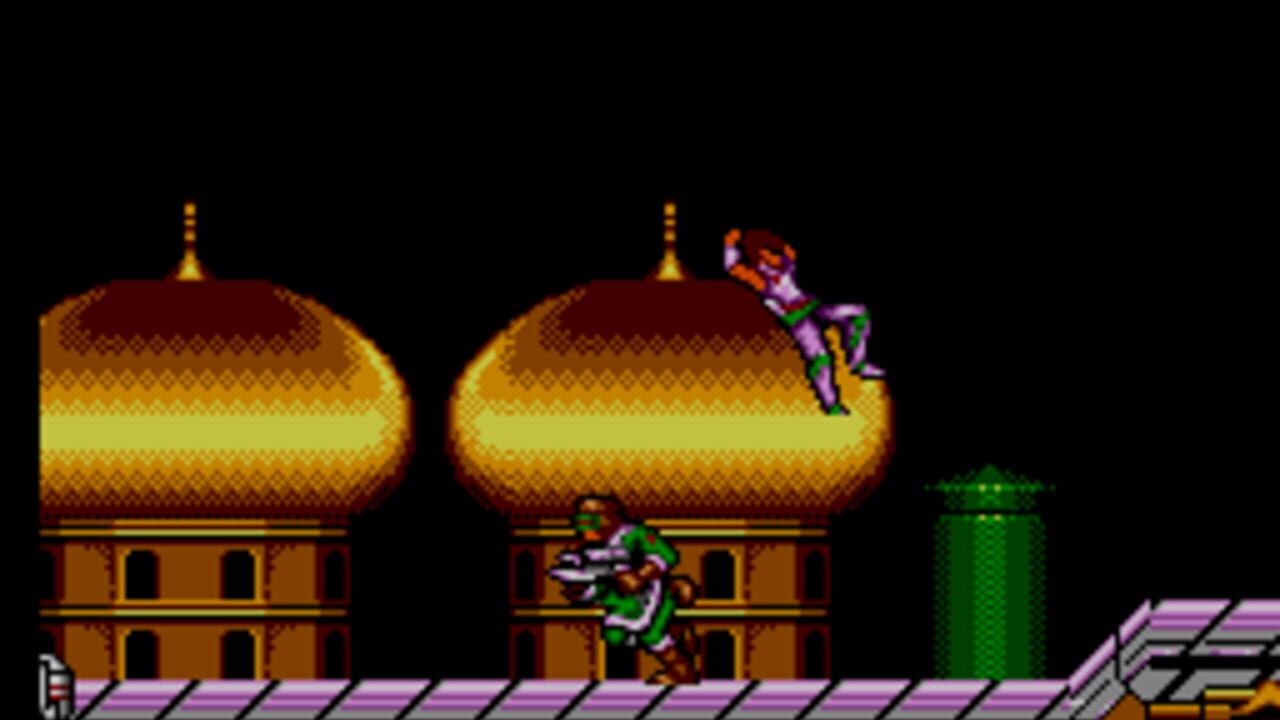
he controls of Strider consist of an eight-way joystick and two action buttons for attacking and jumping. The player controls Hiryu himself, whose main weapon is a tonfa-like plasma sword known as "Cypher". He can perform numerous acrobatic feats depending on the joystick/button combination used. Pressing the jump button while Hiryu is standing still will cause him to do a regular vertical jump, while pressing the jump button while pushing the joystick left or right will enable him to do a cartwheel jump. Hiryu can also slide under or through certain obstacles and enemies by first crouching down and then pressing the jump button. As well as his sliding move, both jumps can also be used to destroy weaker opponents. Hiryu is able to latch onto certain platforms, and climb across walls and ceilings using a metallic hook. While running down a sloped surface, Hiryu can gain enough momentum to allow him to do a longer cartwheel jump than usual. Numerous power-ups can be obtained from item boxes carried by certain enemies. These includes an extension to Hiryu's attack range that lasts for one hundred slashes, two types of health aids (represented by the kanji used to write Hiryu's name: 飛 and 飛竜), a max health extension (represented by the kanji 竜, the second character in Hiryu's name), an extra life, and a power-up that not only makes Hiryu invulnerable to attack but also increases his own attack abilities via shadow images of himself for 15 seconds.[3] Hiryu can also summon robotic companions known collectively as "options" that help him fight enemies. These consist of up to two mushroom-like droids, a saber-toothed tiger and a hawk, known individually as Option A, B and C respectively. The game has five stages: the Kazakh Soviet Socialist Republic (called "St. Petersburg" during the arcade game's attract sequence), the Siberian Wilderness, the Aerial Battleship Balrog (געלראב), the Amazonian Jungle, and the Grandmaster's lair itself, the Third Moon. Each of the stages is divided into a number of smaller sections, each with their own time limit and checkpoint location. The player has a three-point health gauge (which can be increased to five points with the health extensions. Hiryu will lose a life when either his health gauge is fully depleted, by moving him off the screen entirely (like falling into a bottomless pit) or when the game's timer reaches zero. It's Game Over when all of Hiryu's lives are lost, but the player can be given the opportunity to continue.
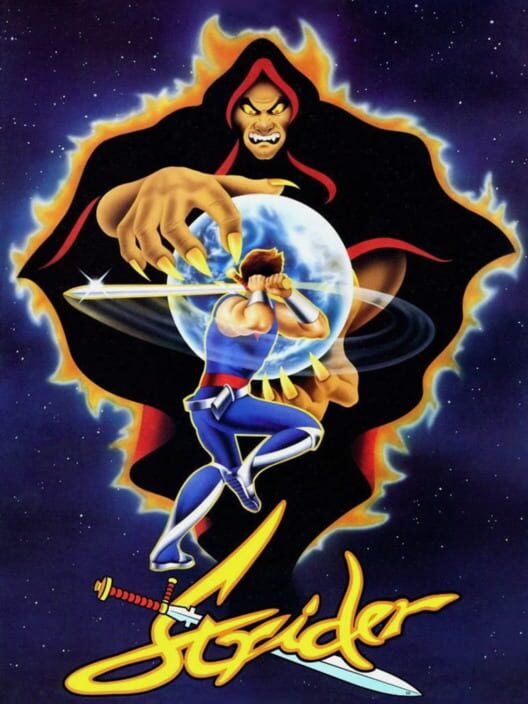
Strider
Genesis · 1989 · NTSC-U · Platform
Activity feed builds as the eBay snapshot history accumulates and comp data flows in. First events surface within hours of a fresh cache cycle; full velocity within seven days.
Live listings
Active tier · Sealed. Aggregated from eBay US. Refreshes every 6 hours.
What it's actually worth
The three-tier spread, verified comparable sales, and where this title sits inside its cohort. Live snapshot lives above in Pulse; this is the time-and-context layer.
The same game at three prices — Loose, CIB, and Sealed on one ruler. The scale is logarithmic: each gridline step is 10×, so the distance between bars shows the size of the jump between tiers.
No verified comparable sales in window. Real comp data integration (Heritage / Goldin / eBay Insights) ships V15.22+.
No verified comparable sales in window. Real comp data integration (Heritage / Goldin / eBay Insights) ships V15.22+.
No verified comparable sales in window. Real comp data integration (Heritage / Goldin / eBay Insights) ships V15.22+.
Why collectors care
The cultural context, the production lineage, the place this artifact holds in its console's history.





- First print documented
- No
- UPC
- 010086011128
- Release date
- 1990-11-20
- Regional / language names
- Strider Hiryuu · STRIDER
Is what you're holding real
Documented variants, identifying marks, and the print-vs-reprint discriminator. Pick a variant to focus the walkthrough; the Companion can talk you through your own copy.
Production reference
No production variants are documented for this title yet. The identifying marks below cover the title's first-print and reprint signals across all tiers.
Production reference
No production variants documented for this title yet. Identification reads against the title's known print signals across all tiers.
No documented marks for this tier yet.
No documented marks for this tier yet.
No documented marks for this tier yet.
Spotted a variant we missed, a print signal we overlooked, or an authentication trap collectors should know about? Contributing a photo or correction earns points toward store credit.
How contributions work→Where else this lives
Five cuts of what surrounds this title — switch the axis to drill into the same-console catalog, the series, the era, the publisher, or ask the Companion for a personal recommendation.